First-time Purchase Discount

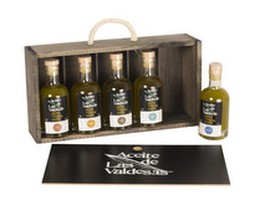
Sign up and get a 5% discount on the price of olive oil on your first order online.

Find out what our customers are saying about Valdesas oils.
Olive oil is a totally natural product that does not expire in any of its varieties or types. It has preferential consumption date, which is something very different as we will go to explain below.
Olive oil producers are obliged to fix in the labelling, and in accordance with Spanish Legislation, (R. D 1334/1999 approving the general standard of labelling, packaging and publicity of foodstuffs, and which indicates in his article 11 that "in any product, the minimum date for consumption or its expiration date" must be included), the date of preferential consumption, which is between 12 and 24 months depending on several factors.
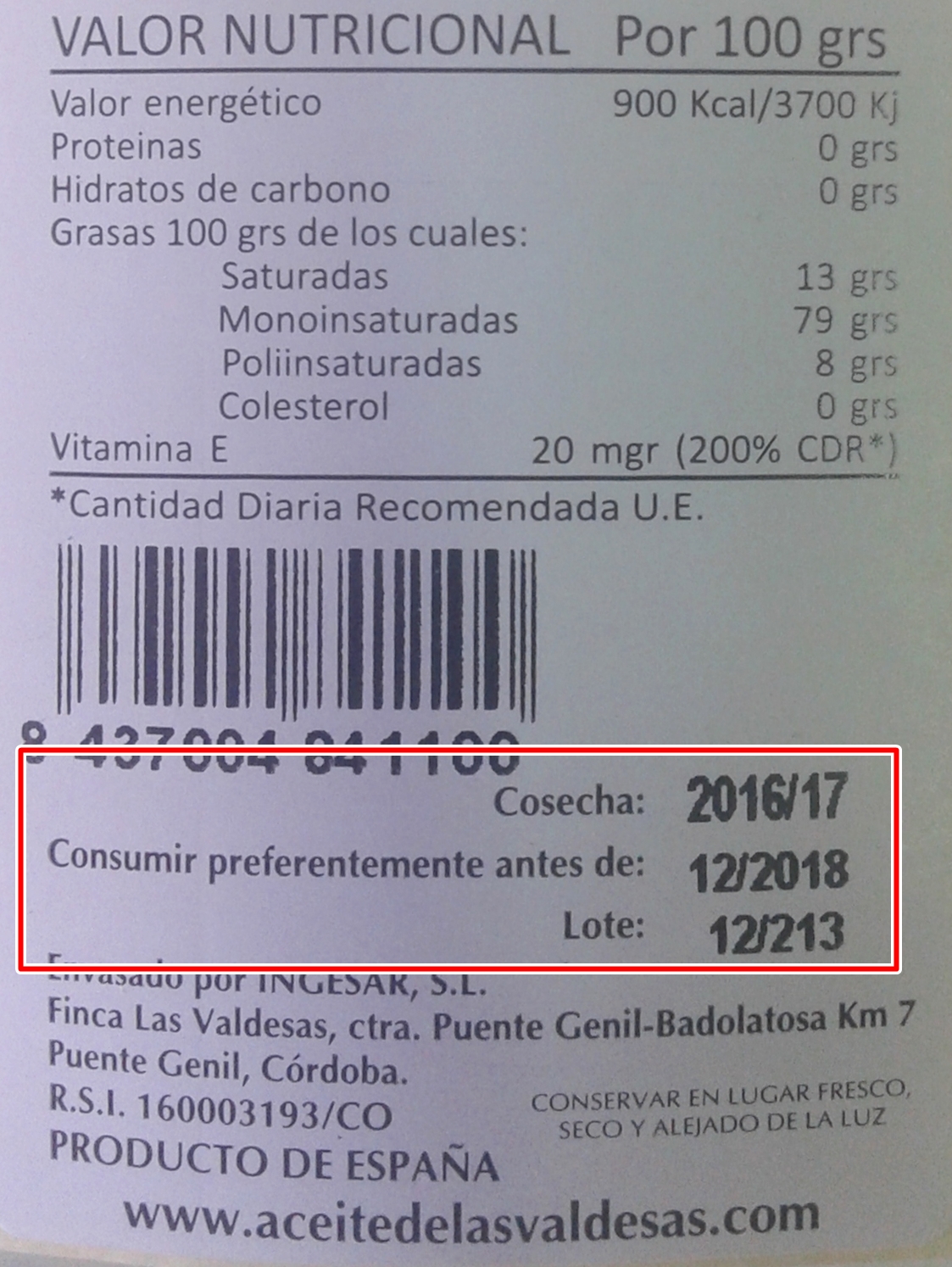
It is essential to clarify that its consumption after that date does not produce any harmful effects for the health, since we talk about preferential consumption and not of expiration date, so, expiration date and preferential consumption date are very different concepts and not always well interpreted.
Although the media are putting special emphasis on this issue and our society is increasingly aware about the quality, origin and production of the products we consume daily, we do not always pay the necessary attention,and it can lead to a clear risk for our health.
It means that from the date written on the label of the product, it is no longer suitable for consumption and must be disposed of. Not doing so can involve health problems. The product may be consumed until the same day as it appears on the label or container, but not from it. In addition to the expiration date, producers must explain a basic description of the appropriate conditions of conservation. As mentioned above, olive oils do not expire.
The preferential consumption date is that on which the producer guarantees that the product preserve its qualities and properties, provided it is maintained according to the appropriate conditions of conservation, both in the store and in the home. The main difference with the expiration date is that the product can be consumed once the preferential consumption date has been reached, without implying any health risk, although its quality may decrease.
In olive oils, the preferential consumption date tends to be between a year and a half and two years, although its durability will depend on several factors such as transport, adequate conservation in both store and home, type of container, type of oil varieties... (Click for Olive oil conservation).
The durability of a food product cannot be mathematical. For their better conservation, we must not only consider the method or process of production, but also each and every one of the factors mentioned above.
They are the production or packing companies who, following strict sanitary and quality criteria, are responsible for setting the dates of preferential consumption of food products in general and olive oils in particular, their conservation will be the recommended one in the labelling of the packagings, so the oils must be kept in a cool place between 18 and 20 º, dry, away from the light and protected from intense smells. A suitable date is set for consumption with safety margins, always advising the customer to consume it before the indicated period of time, this way he can taste and enjoy all the flavors, nuances and aromas of the product. The expiration date on the product does not mean that it is no longer suitable for consumption.
Not all olive oils have the same life span. The producer must bear in mind that the durability of an olive oil will also depend on other factors than its adequate conservation as explained in the above paragraph. These factors are:
• Harvest: As the olive oil is a totally natural product, a juice of olives that does not contain preservatives or stabilizers, the best freshness of the product and its durability is conditioned to that it belongs to the harvest or campaign in source. Although legally it is not obligatory to indicate in the labels the campaign to which they belong, in Las Valdesas we mention it expressly, so that the customer knows that he is consuming a fresh olive oil and totally guaranteed.
• Oil type: Extra virgin olive oil has a higher stability given its high antioxidant content, so it will be kept in better condition until it reaches the preferential consumption date that other olive oils such as olive pomace oil , olive oil or virgin olive oil.
• Oil variety: There are varieties within the extra virgin olive oils, which are preserved better than others. For example, picual, due to its high content in antioxidants, oleic acid and polyphenols, it keepts its aromas and flavors for longer than other more unstable ones such as Arbequina. This does not mean that a variety of olive oil could be better than other, but we must take into account its consuming peculiarities following the recommended periods.
• Type of packaging: Any container marketed today that complies with the regulations for the packaging of olive oils is perfectly suitable. However, depending on the period of consumation, some could be better than others. If you want to keep the olive oil for a long period and in better conditions, we recommend it in tin, cans or dark glass bottles. If on the contrary, you will consume it soon and you want to buy it in a cheaper price, we recommend pet bottles, taking the precaution to preserve them properly, not exposing them to high temperatures and protecting from the light both natural and artificial.