First-time Purchase Discount


Find out what our customers are saying about Valdesas oils.
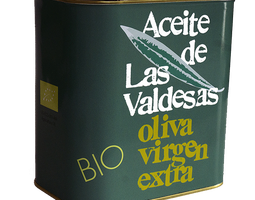
Organic Olive Oil from Las Valdesas State. 2,5 litres.
Organic olive oil is olive oil produced in accordance with the European Regulation on organic production and the labelling of organic products (EU Regulation 2018/848).
We are going to be a little more specific.
Las Valdesas produces Organic olive oils and Integrated Production olive oils (a production scheme between conventional and organic production). The differences between organic and conventional production are mainly based on the cultivation methods and the management of the olive grove, according to the following aspects:
1) Pest Control. Organic cultivation does not allow the use of synthetic pesticides. Instead, alternative methods must be used, such as traps, encouraging the proliferation of natural predators of pests, the use of olive-tree varieties resistant to frequent or endemic pests, or heat treatments (as used against Verticillium). It is also possible to use, in a restricted way, an approved list of natural products (of animal, vegetable, microbial or mineral origin) to fight pests.
2) Weed Control. As with pest control, synthetic herbicides are not allowed for weed removal. Some organic farmers graze herds of sheep or goats among the olive groves to eliminate weeds. This has the added advantage of providing organic fertiliser to the soil. We cut the weeds and remove them from around the base of the olive trees using manual machinery.
3) Fertilisers. Organic olive oil farms cannot use synthetic fertilisers (Urea Ammonium Nitrate, etc.). Only organic fertilisers of animal origin (manure) or vegetable origin (compost) may be used. In our case, we use alperujo from our mill to produce compost, which we incorporate into the soil after a maturation process of about a year. From our point of view, it is more expensive, since the application and spreading of compost is considerably more expensive than applying urea through the irrigation water or by foliar application.
With all the above requirements, we are able to produce organic olives. The following measures must be taken during the organic olive oil production process:
1) Upon reception at the mill and during the processing stage, olives and olive oil must always be in contact with stainless steel, food-grade rubber (for the conveyor belts) or food-grade resins. We began doing this more than ten years ago, when we started producing Integrated Production olive oil.
2) In mills like Las Valdesas, which grind organic olives and Integrated Production olives, it is necessary to follow a strict traceability process by controlling when each type of olive is milled. This aspect was already required for Integrated Production.
3) Analytical tests for pesticide residues are carried out to confirm that the olive oil is free from them. We have been carrying out such tests for many years on our Integrated Production olive oils, and the results have always shown the absence of pesticide residues.
Let us be clear on this point: We are convinced that producing olive oil according to organic methods does not result in higher quality than olive oil produced by conventional methods.
The key aspects of producing a high-quality extra virgin olive oil, such as obtaining olives in perfect condition, harvesting them at the right stage of ripeness, milling them quickly after harvesting, at a low extraction temperature, and preserving the olive oil against oxidation, are not determined by the organic farming method. On the contrary, organic farming may even make them more difficult to achieve.
We are convinced that an experienced olive oil taster is not able to distinguish, in a blind tasting, an organic extra virgin olive oil from another extra virgin olive oil produced by conventional methods.
In other organic products, such as eggs, chicken or meat, the fact that they come from organic production can contribute to their quality, and this may be appreciated by the consumer. However, in the case of olive oil, we believe that this is not possible. We think so because conventional extra virgin olive oil is already a natural food: it is olive juice and contains neither preservatives nor additives.
We believe that there are two reasons:
1) For health and food safety. By consuming organic extra virgin olive oil, you have the confidence of consuming an olive oil without traces of pesticides or other contaminants.
2) To contribute, through your purchase, to environmental sustainability, by supporting a production system that is more respectful of natural resources.
Yes, all these terms refer to the same product, produced according to the rules of organic farming.
In some countries, such as Spain, the word "ecologic" is more commonly used, whereas in France they prefer "biological". In Germany, both terms are used.
European regulations cover both terms, ecological and biological, and allow the use of both "Bio" and "Eco" in their labelling.
"Organic" olive oil is used as a synonym for the previous two terms, although it is not included in the official labelling.
Another adjective that is also used is "biodynamic", originating from the world of wine. As far as we know, in order to describe a product as biodynamic, it must first have been certified as organic.
European Regulation (2018/848) specifies that the control of organic food producers is carried out by a control agency, i.e. private companies authorised by the Ministry of Agriculture to certify that producers comply with all the requirements of the European Regulation.
They request documentation from the producer and carry out field audits to detect possible fraud. They inspect machinery and tools, and take samples of soil, leaves and fruit if they consider it necessary. They also monitor the traceability of the organic olives until they are processed into olive oil and placed into storage.
The control agency that certifies the olive oils of Las Valdesas is CAAE (Andalusian Committee of Ecological Agriculture), which, despite its name, is a private company. It is the most experienced company in Andalusia in organic farming.

The control agency logo may also be included, although this is optional.
Las Valdesas organic olive oil comes from the expansion of our olive groves, following the purchase of an adjoining plot. It covers about 34 hectares of Hojiblanca and two other plots of intensive Arbequina olive groves.
The land was purchased in 2015, and the field must be farmed for three years under the organic farming regulations before its olives can be certified as ecological. Therefore, in the 2018/2019 season, we will have organic olive oil available for sale.
It will be available as a blend of the two varieties mentioned above, and only in a 2.5 litre can.
In the map below, you can see the location of the new ecological plot, shown in green, within our olive groves.