First-time Purchase Discount

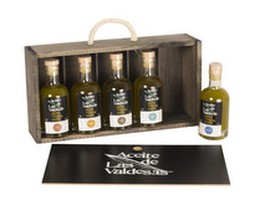
Sign up and get a 5% discount on the price of olive oil on your first order online.

Find out what our customers are saying about Valdesas oils.
Extra Virgin Olive Oil is the highest-quality category of virgin olive oil.
For an olive oil to be classified as extra virgin, it must meet two requirements: a chemical requirement, represented by its acidity, and a sensory assessment of its flavour and aroma, carried out by trained tasting panels.
Many people do not understand why a tasting panel is needed to classify an extra virgin olive oil. In fact, tasting is required for the classification of all virgin olive oils because, like fruit juice, much of their quality lies in their aromas and flavours. At present, no laboratory instrument can assess these characteristics as accurately as the human nose and palate.
1.- The acidity must be 0.8º or lower.
2.- In a tasting panel, the median of the defects must be zero, and the median fruitiness must be greater than zero.
In addition to these two requirements, the legislation includes several other analytical parameters designed mainly to detect fraud or mixtures with other oils, rather than to classify virgin olive oils.
The olive oil is assessed by a tasting panel made up of several experienced tasters, normally between seven and twelve. Having several tasters helps to increase the objectivity and reliability of the final result.
Let's suppose the panel consists of nine tasters. Each taster scores the most intense defect detected in the olive oil. If no defect is detected, the score is zero. Once all the tastings have been completed, the scores are arranged from the lowest to the highest, as shown below:
| Taster | 1 | 2 | 3 | 4 | 5 | 6 | 7 | 8 | 9 |
|---|---|---|---|---|---|---|---|---|---|
| Score for the most intense defect | 0,0 | 0,0 | 0,0 | 0,0 | 0,0 | 1,2 | 1,4 | 1,8 | 1,9 |
The median is the score given by the fifth taster, because it is the middle value when the scores are arranged from lowest to highest. In this example, the score is 0.0, so the median of the defects is zero.
If the panel has an even number of tasters, the median is calculated as the average of the two middle scores.
Now let's suppose the same tasters evaluate the fruitiness of the olive oil. Once again, the scores are arranged from the lowest to the highest:
| Taster | 1 | 2 | 3 | 4 | 5 | 6 | 7 | 8 | 9 |
|---|---|---|---|---|---|---|---|---|---|
| Fruitiness score | 0,0 | 0,0 | 0,0 | 1,0 | 1,5 | 2,5 | 3,3 | 3,6 | 4,0 |
The middle score is 1.5, which means the median fruitiness is greater than zero. Therefore, according to the tasting panel criteria, this olive oil would be classified as extra virgin.
In simple terms, a median of the defects of zero means that most of the tasters did not detect any defects in the olive oil, while a median fruitiness greater than zero means that most of them detected a fruity character. To be classified as extra virgin, an olive oil must meet both of these requirements.
The information that the bottler includes on the label of an extra virgin olive oil can be divided into three categories. Firstly, there is the mandatory information required by legislation. Secondly, there is optional information regulated by law, which may only be included if the olive oil meets certain additional requirements. Finally, there is additional information that is not specifically regulated but may be provided by the producer.
Mandatory information:
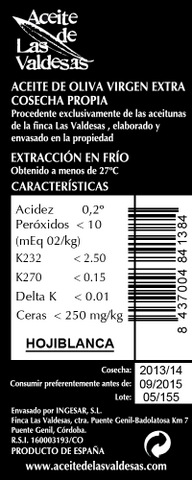
- Category and product description. The category is "Extra Virgin Olive Oil", while the legal description is: "Superior category olive oil obtained directly from olives and solely by mechanical means."
- Best before date. Olive oil does not have a use-by date, so producers indicate a best before date, usually between 18 months and two years after bottling. This is important because many consumers mistakenly believe that the best before date is calculated from the olive harvest, when it is actually based on the bottling date.
- Origin of the olive oil. The label must indicate the country where the olives used to produce the oil were harvested.
- Name and registered details of the bottler.
- Net quantity and batch number.
Optional information:
-"First cold pressing". A producer may use this description only if the virgin olive oil has been obtained at a temperature below 27°C by a first mechanical pressing of the olive paste using a traditional extraction system with hydraulic presses.
-"Cold extraction". This term may be used only if the virgin olive oil has been obtained at a temperature below 27°C by centrifugation or percolation of the olive paste. Nowadays, almost all modern olive mills use this extraction system.
-Acidity or maximum acidity. The producer may indicate the olive oil's acidity only if it is accompanied by the values for the peroxide value, wax content and ultraviolet absorption (K232, K270 and ΔK), measured at the same time.
-Organoleptic characteristics. Sensory descriptions such as fruity, bitter or pungent may only appear on the label if they are based on the results of an official sensory assessment carried out in accordance with the methods established by European legislation. In practice, this means they must be supported by the results of an official tasting panel.
Additional information:
Producers are free to include any additional information they consider useful or relevant, provided that it is accurate and does not mislead consumers. At Las Valdesas, we have chosen to include the following information:
-Harvest year. We indicate the harvest season in which the olives were picked. As the olive harvest normally begins in October and may continue until January or February, we show both years (for example, 2024/2025). We believe this is useful information because olive oil gradually loses some of its aromas and nutritional properties over time.
-Olive variety. At Las Valdesas we produce 100% single-variety extra virgin olive oils, so the label clearly states the olive variety from which each oil is made. In the example shown, the variety is Hojiblanca.
-Estate-grown olives. We indicate that the olive oil has been produced exclusively from olives grown on our own estates. This allows us to control every stage of the process, from cultivation and harvesting to milling and bottling.
Other producers may choose to highlight different characteristics that they consider important, such as mountain-grown olives, olive groves with centuries-old trees, rain-fed cultivation or other distinctive features of their oils.
Likewise, producers may decide not to mention certain characteristics even if they apply. For example, Las Valdesas bottles its olive oils unfiltered. We could have included this information on the label, and even warned consumers about the possible presence of natural sediment, but we simply did not have enough space on the label to do so.
Sources:
Requirements for Extra Virgin Olive Oil:
Commission Implementing Regulation (EU) No 1348/2013 of 16 December 2013, amending Regulation (EEC) No 2568/91. (View PDF)
Commission Regulation (EEC) No 2568/91 of 11 July 1991 on the characteristics of olive oils and olive-residue oils and on the relevant methods of analysis. (View PDF)
"Trade Standard Applying to Olive Oils and Olive-Pomace Oils", International Olive Council (IOC Document COI/T.15/NC No 3/Rev.7, May 2013).
Note: These documents are highly technical. In addition to defining the classification of olive oils, they also specify the analytical methods to be used and provide the statistical definition of the median used in sensory assessment. It should also be noted that the IOC standard includes the category "ordinary virgin olive oil", whereas under current European legislation this category is classified as lampante olive oil.
Extra Virgin Olive Oil Labelling:
Commission Regulation (EC) No 1019/2002 of 13 June 2002 on marketing standards for olive oil. (View PDF)
Regulation (EU) No 1169/2011 of 25 October 2011 on the provision of food information to consumers. (View PDF)
Note: The latter Regulation introduced the requirement to include nutritional information on food labels. This requirement became mandatory from 13 December 2014.