First-time Purchase Discount

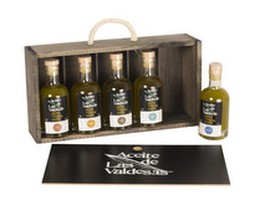
Sign up and get a 5% discount on the price of olive oil on your first order online.

Find out what our customers are saying about Valdesas oils.
Frying is the procedure of cooking the food introducing them in hot olive oil. The temperature should be a little higher than the boiling point of water, between 130 and 190 °C.
The goal is that when you enter the food into the hot oil, a crust around it will be formed that prevents the oil penetrates the food and this is cooked with its own water content. The result should be a food golden and crunchy on the outside and cooked on the inside, without being soaked in oil.
Olive oil should not exceed 200 °C, because at this temperature begin to break down the fatty acids. In other words, the oil begins to smoke and burn out.
The temperature of the olive oil must be steady during frying. It must be ensured that the temperature does not go down too much when entering the food. It is therefore recommendable that the food is at room temperature, introducing it into the Olive Oil slowly.
The frying temperature depends on the water content in the food and the size of the pieces. At higher water content, more time should be frying and at a lower temperature, in order to have enough time to cook the inside without burning the surface. For example the chips require much time due to its high water content, and it is recommended that you fry them at 130-150ºC. The “fried fish” or the croquettes need less time and can be fried to 180ºC.
It is important to introduce the food as dry as possible, because the water favors the decomposition and oxidation of the oil; in addition to avoid splashing. In this sense it is important that the olive oil is hot when entering the food so that the water of them evaporate quickly. It is also important to fry foods without covering the frying pan so that the water vapor does not go back to the Olive Oil.
After using the oil for frying, it is convenient to filter it. The particles that remain in the Olive Oil facilitate its decomposition.
You must not mix oils with new oils. Arrange an Olive Oil for fried fish and other for general use.
Following the above tips of conservation, you can use 4 or 5 cycles of frying with olive oil, according to the International Olive Oil Council.
You can detect that the olive oil is burned when you notice a dark color on it, irregular and not agreeable smell and appear foams. However, even when you do not have these features, you should not exceed the cycles of frying previously recommended.
The electric fryer has the great advantage that it is very comfortable to use, having a thermostat to regulate the temperature of frying. But under our point of view it is its sole advantage.
In the frying pan you can use the amount of oil in terms of what is to be fried, and although does not have thermostat, make fritters are healthier.
The great problem of the electric fryers is that they need a large quantity of olive oil. In general, they usually have more than two or three liters of capacity. If we want to make some fried foods healthy, we need to use plenty of oil to make 4 or 5 uses. This is why we believe that its use is less economic that the frying pan. Moreover we must clean the electric fryer with each oil change.
Remember the greasy smell of some establishments with large electric fryers that use sunflower oil, which supposedly should be used only for 1 or 2 cycles of frying, because the sunflower oil degrades before the olive oil. We think it is very unlikely that they do so, as it would be completely unprofitable.