First-time Purchase Discount

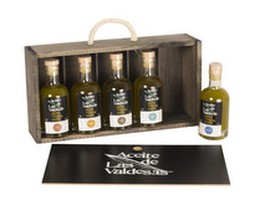
Sign up and get a 5% discount on the price of olive oil on your first order online.

Find out what our customers are saying about Valdesas oils.
The density of olive oil is 0.916 kg/litre. This density corresponds to a temperature of 17 °C. As the temperature increases, olive oil expands and its density therefore decreases.
The difference in density between olive oil and water has traditionally been used by olive oil producers to separate the water from the oil. In the past, they were separated in settling tanks by decantation. After a certain period of time, the olive oil rose to the top of the tank, while the denser water settled at the bottom together with the remaining solid particles.
Modern extraction processes also make use of the difference in density between olive oil and water. The olive paste and the remaining components are separated according to their density by means of a centrifugation process.
| Temperature (°C) | Density (kg/litre) | Temperature (°C) | Density (kg/litre) |
| 6 | 0.9230 | 18 | 0.9150 |
| 7 | 0.9224 | 19 | 0.9144 |
| 8 | 0.9217 | 20 | 0.9137 |
| 9 | 0.9210 | 21 | 0.9130 |
| 10 | 0.9204 | 22 | 0.9124 |
| 11 | 0.9197 | 23 | 0.9117 |
| 12 | 0.9190 | 24 | 0.9110 |
| 13 | 0.9184 | 25 | 0.9104 |
| 14 | 0.9177 | 26 | 0.9097 |
| 15 | 0.9170 | 27 | 0.9090 |
| 16 | 0.9164 | 28 | 0.9084 |
| 17 | 0.9157 | 29 | 0.9077 |
It is often said that olive oil "expands" in the frying pan when heated. This is easy to observe as the temperature rises. But how much does it actually expand?
To calculate this, we need to know the coefficient of thermal expansion of olive oil. This ranges between 7.2 × 10⁻⁴ and 7.9 × 10⁻⁴. (For this calculation, we assume a value of 7.9 × 10⁻⁴).
If olive oil is heated from 20 °C to 180 °C for frying, its volume increases by approximately 12.7% (α × ΔT = 7.9 × 10-4 × (180 − 20)).