First-time Purchase Discount

Soon, we will start harvesting the olives. Do you wish to be notified when the olive oils of the new crop are available? Enter your name and email address and we will inform you.
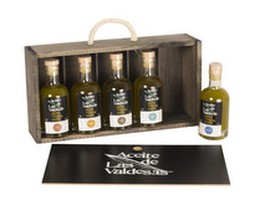
Sign up and get a 5% discount on the price of olive oil on your first order online.
Spain is the world's largest producer of olive oil. Around 2.5 million hectares of land are dedicated to olive cultivation in Spain, an area roughly equivalent to the size of the island of Sicily.
In Spain, most olive oil is produced in the south. By region, Andalusia accounts for approximately 80% of Spanish production. The remaining 20% is distributed across other regions, including Castilla-La Mancha, Extremadura, Catalonia and Aragon.
Percentage of production (%) of Extra Virgin Olive Oil and Virgin Olive Oil by region in Spain (2019–20 harvest).
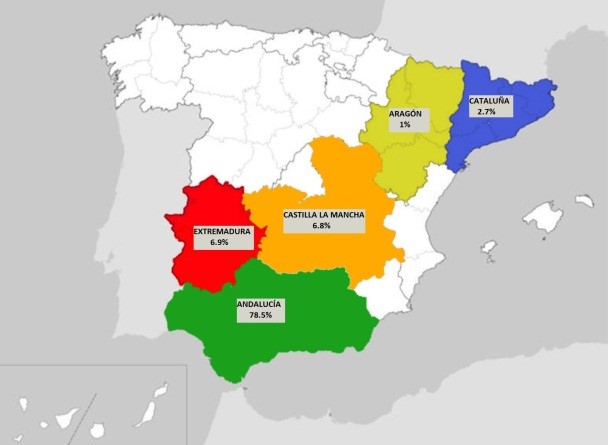
Source: Ministry of Agriculture, Fisheries and Food, Government of Spain.
Amount of Extra Virgin Olive Oil and Virgin Olive Oil produced in Spain, 2019–20 harvest.
| Regions | Tonnes (t) | Percentage (%) |
| Andalusia | 710,052 | 78.5 |
| Castilla-La Mancha | 61,230 | 6.8 |
| Extremadura | 62,124 | 6.9 |
| Catalonia | 24,393 | 2.7 |
| Aragon | 8,628 | 1.0 |
| Rest of Spain | 38,462 | 5.4 |
Olive groves cover around 15% of the total area of Andalusia. The provinces of Jaén and Córdoba are the main producers, followed by Granada and Seville.
Percentage of production (%) of Extra Virgin Olive Oil and Virgin Olive Oil by province in Andalusia (2019–20 harvest).
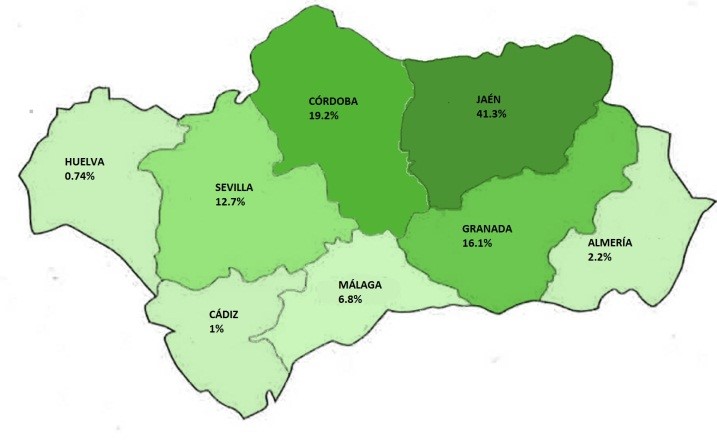
Source: Ministry of Agriculture, Fisheries and Food, Government of Spain.
Amount of Extra Virgin Olive Oil and Virgin Olive Oil produced in Andalusia, 2019–20 harvest.
| Provinces | Tonnes (t) | Percentage (%) |
| Jaén | 293,111 | 41.3 |
| Córdoba | 136,603 | 19.2 |
| Granada | 114,378 | 16.1 |
| Seville | 89,617 | 12.7 |
| Málaga | 48,268 | 6.8 |
| Almería | 15,370 | 2.2 |
| Cádiz | 6,976 | 1.0 |
| Huelva | 5,279 | 0.7 |
Jaén is also known as the "World Capital of Olive Oil". The province is particularly renowned for the cultivation of the Picual variety. Its dry climate and hot summers are ideal for olive cultivation, and olive trees can be found everywhere, from the valleys to the mountains. This spectacular "Sea of Olive Trees" has been proposed for inclusion on the UNESCO World Heritage List as the world's largest man-made forest.
.jpg)
.jpg)