First-time Purchase Discount

Sign up and get a 5% discount on the price of olive oil on your first order online.

Find out what our customers are saying about Valdesas oils.
Oleic acid is a monounsaturated fatty acid from the omega-9 family of fatty acids.
It is mainly found in vegetable oils such as olive oil, avocado oil, safflower oil and canola oil.
Olive oil consists of between 61% and 83% oleic acid, depending on the olive variety and the climate. The oleic acid content does not depend on the quality of the oil, the extraction method (mechanical or using chemical solvents), or whether the olive oil has been refined.
The main characteristic of oleic acid is that it is the most stable unsaturated fatty acid:
Many of the beneficial properties of olive oil come directly from oleic acid. Its main health benefit is its protective effect on the cardiovascular system through several mechanisms. Firstly, it helps to lower blood pressure and, secondly, to reduce LDL ("bad") cholesterol while increasing HDL ("good") cholesterol (Learn more about the effects of oleic acid and olive oil on cholesterol).
You can discover all the health benefits of olive oil by following the link below.
In its pure form, oleic acid is a colourless and odourless liquid.
Its melting point is 15 ºC. Therefore, olive oil solidifies when the temperature falls below this value.
Its boiling point is 360 ºC. However, for cooking purposes, the smoke point is more relevant, as it determines the maximum temperature at which an oil can be used for frying before it begins to break down. Olive oil, which is composed mainly of oleic acid, has a smoke point below 220 ºC.
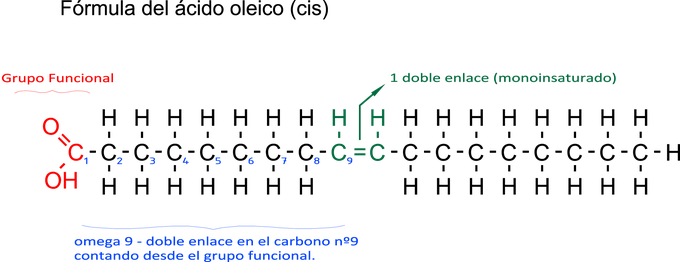
The molecular formula of oleic acid is C18H34O2.
Like all fatty acids, the oleic acid molecule has a carbon chain structure with the carboxyl functional group (COOH) located at one end.
Within the carbon chain, there is a double bond between carbon atoms 9 and 10 (counting from the functional group), which gives oleic acid its monounsaturated character. It belongs to the omega-9 family of fatty acids, and many of its health benefits are derived from this chemical characteristic.
Most olive oil is made up of oleic acid. However, the amount varies depending on the olive variety used to produce the oil. Some varieties naturally contain a higher proportion of oleic acid than others. Below is a table showing the approximate oleic acid content of several olive varieties.
| Olive variety | % oleic acid |
| Picual | 76 |
| Cornicabra | 77 |
| Hojiblanca | 74 |
| Frantoio | 67 |
| Manzanilla | 72 |
| Arbequina | 65 |
Each vegetable oil contains a different proportion of fatty acids. This fatty acid fraction is known as the saponifiable fraction. A chart showing the saponifiable fractions of various vegetable oils can be found here.
In addition to most vegetable oils, which contain varying amounts of oleic acid, another important source is nuts, including almonds, peanuts, hazelnuts, pistachios and walnuts.
Oleic acid is also found, although in smaller amounts, in certain meats, such as pork.
High oleic sunflower oil is sunflower oil from sunflower plants that have been genetically modified to produce more oleic acid. It is widely used in the food service industry.