First-time Purchase Discount

Which is the best olive oil for salads?
How to Tell If Olive Oil Has Gone Bad
What is the best olive oil for toast?
How much oil does an olive tree produce?
Puente Genil Olive Oil. “Optimi Olei Emporium”
Where is olive oil produced in Spain?
.
What is an Acebuche (Wild Olive Tree)?
Which is the density of oil?
Las Valdesas Extra Virgin Olive Oil Price per liter
Unrefined olive oils
Olive Oil from Córdoba, Spain
What does AOVE mean?
What are the main olive oil producing countries?
What Is Olive Oil Used For?
The olive tree flower
.
The best olive oil for salads is extra virgin olive oil. It is the most flavourful and fruity type of olive oil.
But, of course, there are many varieties of extra virgin olive oil, each with its own characteristics. So, we recommend one or more varieties of extra virgin olive oil for each type of salad.
For fresh salads with plenty of greens and vegetables, such as the typical summer salad with lettuce, tomatoes, onion, cucumber, carrots, etc., we recommend an extra virgin olive oil such as Picual or Manzanillo. Their fresh and herbaceous notes pair perfectly with these ingredients and enhance their flavours, adding character to ingredients that may otherwise lack flavour, as sadly happens all too often. (There are no tomatoes like the ones we used to have!)
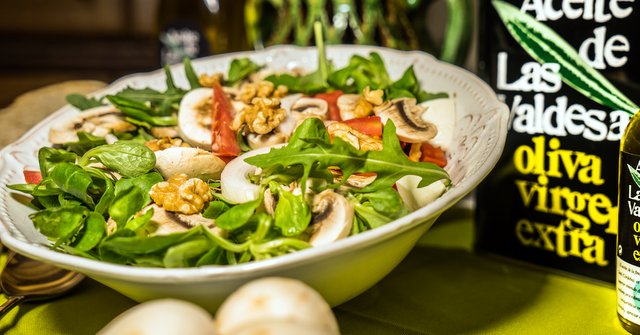
For salads containing fruits such as apples, avocado, raisins, oranges and dried fruits, as well as pasta salads or salads with broccoli and cheese, we recommend Hojiblanca olive oil. Its characteristics pair particularly well with these ingredients. In tasting panels, Hojiblanca extra virgin olive oil often shows notes of apple, almond and dried fruit, and it is generally less herbaceous and bitter than Picual.
For salads made exclusively with fruit, such as pears, bananas, strawberries, berries, kiwi, etc., we recommend Arbequina extra virgin olive oil. Its sweet notes and lack of bitterness make it ideal for this type of salad.
These are our recommendations based on our own tastes and experience. You can try them and form your own opinion.
Bon appétit!
Read moreBelow, we give you some tips on how to tell if an olive oil is in poor condition, apart from checking the best-before date printed on the label:
1) The olive oil has a strange or unusual colour. Extra virgin olive oils can range in colour from deep green to golden yellow. However, colour alone is not a reliable indicator of the quality or condition of an olive oil.
For example, olive oil packaged in a transparent glass bottle or PET container that has been exposed to sunlight or strong light in a shop for a long period of time can develop a reddish colour, similar to that of whisky or cognac.
Another example is olive oil that has been exposed to repeated frying cycles. This can eventually cause the oil to become very dark and may even cause some foam to develop.
2) A rancid smell and taste. Most olive oils in poor condition available to consumers will have become rancid. This means that the extra virgin olive oil has gradually oxidised, either while stored in shops or in the kitchen, and has eventually become rancid.
Rancidity is an unavoidable process in olive oil. It will happen sooner or later, but it can be significantly delayed by following good storage practices.
The smell of rancid olive oil can remind you of varnish, solvents or a freshly painted room, often with a sweet and unpleasant aroma. Olive oil is very likely to have become rancid if it has been open for more than three years and has been stored in a bottle throughout that time.
It is not possible to recover olive oil once it has become rancid. Rancidity is an irreversible process. A mistake that is sometimes made is to mix rancid olive oil with fresh extra virgin olive oil in an attempt to compensate for or mask the rancid flavour. This is not recommended, as the rancid oil already contains oxidation products that can accelerate the deterioration of the fresh olive oil with which it is mixed.
The best-before date is set by the producer at the time of packaging. It is determined based on the condition of the olive oil, its analytical characteristics and the expected storage conditions from the time it is packaged until it reaches the final consumer.
For example, if a producer has a very stable extra virgin olive oil, such as Picual, and packages it in an opaque glass bottle, its properties and extra virgin status can be expected to be preserved for longer than those of a less stable variety, such as Arbequina, packaged in a transparent PET container.
For this reason, it is common for producers to set a best-before date between one and two years after packaging.
It is important to emphasise that the best-before date is not calculated from the date the olive oil was produced, but from the date it was labelled and packaged. Therefore, you may find two extra virgin olive oils packaged on the same date with the same best-before date, even though one was produced two years earlier and the other only recently.
The best-before date should not be confused with a use-by date. The best-before date refers to the period during which the producer expects the olive oil to retain its quality and characteristics when stored correctly.
Read moreStarting the day with a breakfast that includes toast generously soaked in Extra Virgin Olive Oil, the only oil we recommend eating raw, is a great way to start the day because:
But there are several things worth considering when it comes to choosing the right olive oil for toast.
It's a matter of taste. We encourage you to try all the varieties and experiment with different combinations. The ones we suggest here are simply our recommendations.
This is where the olive oil really comes into its own, and there is a big difference between a good Extra Virgin Olive Oil and a mediocre one. Since the oil is the only ingredient, perhaps with a little crushed tomato, we suggest varieties with a strong flavour, such as Picual, or varieties with more complex and balanced flavours, such as Hojiblanca and Frantoio.
And please, do it properly and don't add salt. If you have a good olive oil full of flavour, you simply don't need it. I remember that 30 years ago, the salt shaker was always within reach, but those were different times, and the quality of most olive oils was, to put it mildly, rather poor.
Our favourite option. We might not know much about cooking, but we think this is the perfect combination (forgive us, gastronomes).
For this combination, our preferred choices are Picual and Hojiblanca.
These oils also work very well with toast topped with a little cured cheese.
Here, our preference is for an olive oil from the Arbequina variety, with a mild flavour and no pronounced bitter notes. Its characteristics work particularly well with these ingredients, and it is a healthier alternative to butter.
The only conclusion, and the only advice, is to experiment and try different varieties and combinations. You are sure to be surprised!
I admit that I was hooked on toast with garlic-infused olive oil for quite some time. The classic bottle with a couple of cloves of garlic added to it. For this, very healthy by the way, alternative, you don't really need a top-quality Extra Virgin Olive Oil, because the garlic masks many of the nuances that a good extra virgin can offer. However, personally, I loved toast with Extra Virgin Olive Oil and marinated garlic. I had to give it up because my social life was suffering, despite my conscientious toothbrushing and constant chewing of mint gum.
Sometimes I'm tempted to relapse, but only at dinner, hoping that the intensity of the garlic will disappear overnight. But I haven't even dared suggest it to the family.
Another option is the traditional method of rubbing raw garlic directly onto the bread. This isn't something I've tried much myself. It is undoubtedly more traditional and informal, but less practical, as the smell of garlic gets all over your fingers.
There are basically two ways to do it. You can pour the oil onto a plate and dip small pieces of bread into it, allowing the oil to soak into the bread. Alternatively, you can place half a roll or a slice of toast on the plate and drizzle the oil over the bread using a good oil dispenser.
The first method is easier and is recommended for "beginners". The second, where the aim is to soak the bread without spilling oil all over the plate, is for the more "experienced". With this method, you need to cut the bread into pieces to make sure enough oil is absorbed, especially when using toast.
The big dilemma comes when someone asks: "Is it allowed?" or "Is it acceptable to dip toast in coffee, tea, hot chocolate...?" Everything I've learned about table manners clearly says no... but it's just so good! If you decide to break the rules, make sure you let the excess oil drain from the toast before taking it off the plate, so you don't stain the table or your clothes. And if a few drops of oil do end up in your coffee, don't worry. Just take it as a sign that you've dipped your bread properly.
Read moreIn our case, based on the data we have collected over the last 10 years, the amount of oil produced by an olive tree is around 5 to 10 litres.
So, when you drive through a landscape of olive groves, you can quickly get an idea of how much each tree produces: on average, around one and a half of the typical 5-litre bottles you see in shops.
An olive tree produces more or less oil depending on the following factors:
Let's take a closer look at each of these factors.
When an olive tree is planted, it does not begin to produce fruit immediately. Olive seedlings are usually about one metre tall when bought from a garden centre, just tall enough to be attached to a stake and fitted with a protective guard to prevent rabbits from gnawing at the trunk.
Obviously, such a young tree does not produce olives. You generally have to wait until the tree is 4 or 5 years old before it begins to produce olives. The farmer will harvest the olives even during these early years, despite the fact that it is not economically worthwhile, because leaving them on the tree would slow down its growth.
During these years, the aim is for the trunk to reach a clear height of at least 1 metre without branches, so that the tree can eventually be harvested using a vibrating clamp. The aim is also to develop three main branches from which the crown of the olive tree will grow.
An olive tree in a traditional or intensive planting system can reach its maximum production level between 15 and 20 years of age, depending on water availability, the absence of disease and severe frost, and the correct and sufficient application of fertiliser.
As for the size of the crown, this is limited by the available space, which depends on the planting density.
In traditional olive groves, with a density of fewer than 200 trees per hectare, the olive trees are more widely spaced and are usually larger. As a result, each tree can produce more oil than a tree in an intensive or super-intensive olive grove.
In these traditional olive groves, the limiting factor was not, and still is not, space, but rather the availability of water, especially in rain-fed conditions.
In intensive olive groves, with densities of between 300 and 400 trees per hectare, the development of the crowns is limited by neighbouring olive trees. Consequently, the amount of oil produced per tree is lower than that of a tree in a traditional olive grove.
Another matter to consider is oil production per hectare. In this respect, intensive olive groves usually produce more oil per hectare than traditional olive groves.
Although olive trees have traditionally been grown as a rain-fed crop and can produce fruit without excessive drought, irrigating an olive grove generally increases the amount of oil that each olive tree can produce.
Traditionally, in order to maximise the effect of irrigation on the harvest, the aim has been to use irrigation to compensate for a lack of spring and autumn rainfall in dry years, and to extend the growing season in years when rainfall is otherwise sufficient. In other words, irrigation can extend the spring period into May and June.
Extending the rainy season in autumn would have little effect and could even be counterproductive, as this coincides with the harvest period. In October, the veraison of the olive begins, when the fruit changes colour from green to purple. Once this process begins, the production of oil inside the olive (lipogenesis) comes to an end. Any additional water supplied to the olive tree therefore mainly increases the water content of the fruit, which can make oil extraction at the mill more difficult.
Weather conditions can have a significant effect on olive production. In addition to water availability, whether from irrigation or rainfall, the main factors are the following:
Alternate bearing is a very common phenomenon in olive cultivation. The Spanish term "vecería" refers to the natural tendency of an olive tree to produce a large crop one year followed by a smaller crop the following year.
In other words, a large olive harvest in one year is often followed by lower production the next, as the tree needs time to recover.
We have always thought that alternate bearing was partly due to traditional farming practices, in which the harvest was delayed in order to achieve the highest possible oil yield. We believed that this delay prevented the olive tree from recovering in time, combined with a possible deficit of nutrients needed for fruit formation, particularly phosphorus.
However, we have gradually come to think that alternate bearing, although it can be reduced through modern agricultural practices, is an inherent characteristic of the crop.
This section covers the proper use of fertilisers and treatments.
However, pruning deserves a special mention, as it is one of the most debated and subjective aspects of olive cultivation.
Olive tree pruning is always an interesting topic of discussion among farmers because there are many different approaches.
There are many types of pruning: crown formation, maintenance pruning, rejuvenation pruning and, essentially, almost any adjective you can think of.
Pruning is essential for making the best possible use of all the resources available to the olive grove and directing them towards olive production.
The overall objective of pruning is to create an orderly, well-ventilated tree crown that receives sufficient sunlight for the proper development of the greatest possible number of fruits.
The strategies and techniques used to achieve this objective can be found in any good olive-growing manual, although different approaches and criteria are gradually becoming more closely aligned.
Read more
Located in the geographical centre of Andalusia, on the border with the provinces of Seville and Málaga, Puente Genil lies in the heart of the Córdoba countryside, surrounded by olive groves and vineyards and crossed by the Genil River, which gives the town its name. Since ancient times, Puente Genil has played an important commercial and industrial role in the region and has a centuries-old tradition of olive cultivation. Its soils and climate provide ideal conditions for producing distinctive olive oils that are recognised worldwide.
Its olive oil has been highly regarded for more than 100 years. In early 1936, the Spanish newspaper ABC reported a unique event with no precedent in the history of Spain. On 15 October 1935, the National Association of Olive Growers of Spain, at its General Assembly, awarded Puente Genil the special title of OPTIMI OLEI EMPORIUM, meaning approximately “the emporium of the finest olive oil”. This historic title can still be seen today on the coat of arms of Puente Genil.
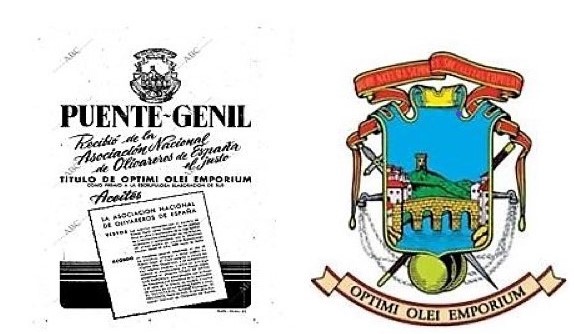
Part of the municipality of Puente Genil lies within the Estepa Protected Designation of Origin (PDO).

The Estepa PDO covers eleven municipalities in the province of Seville and one in the province of Córdoba: Puente Genil, specifically the area known as Miragenil.
Las Valdesas, a producer of extra virgin olive oil, is an associated member of the PDO.
Estepa PDO oils are produced from the varieties Hojiblanca, Manzanilla, Arbequina, Picual and Lechín, with Hojiblanca being the predominant variety. Depending on the variety, these oils may have fresh or ripe fruit aromas and flavours, with slightly bitter and/or peppery notes or a mildly sweet character.
They are obtained exclusively through mechanical or physical processes that do not alter the oil, preserving the flavour, aroma and characteristics of the olives from which they are produced.
Compared with other Protected Designations of Origin in Andalusia, the Estepa Protected Designation of Origin follows particularly demanding quality and production standards. Its members are committed to sustainable olive farming, using techniques that respect the environment. The area's climate, soil characteristics and olive varieties contribute to the distinctive character of the olive oils produced here.
Only olives grown in olive groves belonging to the PDO's designated geographical area may be used to produce oils bearing the Estepa PDO designation. The resulting extra virgin olive oils are recognised for their quality and have received numerous awards both in Spain and internationally.
Puente Genil is home to several olive oil producers and olive mills.
.jpg)
The Las Valdesas estate is located within the municipality of Puente Genil, close to the border with the Sevillian towns of Badolatosa and Casariche.
The estate's own olive mill is located on the farm itself and processes only olives harvested from its own olive groves.
Five olive varieties are grown at the Las Valdesas estate: Arbequina, Hojiblanca, Picual, Manzanillo and Frantoio.
Las Valdesas is an associated member of the Estepa PDO and holds certifications for Integrated Production in Olive Growing and Olive Milling, as well as Organic Production.
Las Valdesas has received several national and international awards, including an award for the Best Extra Virgin Olive Oil in Spain, presented by the Spanish Ministry of Agriculture and Fisheries in the ripe-fruity category. These achievements contribute to the long-standing reputation of Puente Genil as the “Optimi Olei Emporium”.
Founded in 1885, Aceites Cortijo El Canal is a family-run business with more than 130 years of experience producing extra virgin olive oil.
Founded in 1958, the cooperative began producing olive oil that same year.
It went on to become one of Spain's leading olive oil cooperatives in terms of olive processing volume, reaching a maximum production of 36 million kilograms of olives.
The cooperative was established in 1954. Its olive oil is marketed under the Oleoestepa S.C.A. brand, a second-tier cooperative. It is part of the Estepa Protected Designation of Origin and holds certification for Integrated Production in Olive Growing and Olive Milling. For the marketing of its table olive production, the cooperative is also part of DCOOP S.C.A.
In 1970, a group of enterprising farmers from Puente Genil came together to establish the Cooperativa Vitivinícola La Purísima.
As many of its members also cultivated olive groves, the cooperative later decided to build an olive mill equipped with modern technology for olive oil extraction, as well as a facility for processing table olives.
It became the first cooperative in the area to combine the production of wine, olive oil and table olives. Today, the cooperative operates commercially under the name VINOLEA, Bodega & Almazara and has more than 300 members. Its main production is extra virgin olive oil, followed by table olives and wine.
MkOliveco was founded on the experience of three generations dedicated to the production and marketing of Andalusian olive oils.
Its main facilities are located close to the Subbética Natural Park and western Granada, within the area between southern Córdoba, western Granada and southern Jaén. Its olive oil is marketed under the Oro Español brand.
This olive mill produces exclusively early-harvest extra virgin olive oils. It works exclusively with the Hojiblanca and Arbequina varieties.
Traditionally, olive growing in this region has been predominantly a rain-fed form of agriculture.
A rain-fed olive grove is one that relies entirely on rainfall for its water supply. Production therefore depends on the amount of rainfall received during the year and how evenly that rainfall is distributed throughout the growing season.
Olive trees are particularly well adapted to prolonged periods of drought and can produce fruit even when water availability is limited. This has favoured rain-fed olive farming for centuries. The olive tree is characteristic of the Mediterranean climate and is highly tolerant of drought. It is well suited to rain-fed cultivation thanks to its extensive root system and the structure of its leaves, which help to reduce transpiration and moisture loss.
However, many olive growers have now introduced irrigation into traditionally rain-fed olive groves in response to the problems that prolonged water shortages can cause for olive production.
Olive trees generally respond well to an adequate supply of water, and irrigation can significantly increase productivity. This has brought important changes to olive farming in Andalusia by allowing growers to achieve higher yields where water resources are available.
The two main olive varieties grown in Puente Genil are Hojiblanca and Picual.
Hojiblanca is the most widely cultivated olive variety in Puente Genil. Its name refers to the whitish or silvery appearance of the tree's leaves. The olives are used both for producing olive oil and as table olives.
The variety is widely cultivated throughout Andalusia. Historically, its origins have been associated with the province of Córdoba, with its main area of cultivation extending across southern Córdoba, Seville and northern Málaga.
Picual is the most widely cultivated olive variety in Spain and one of the world's most important olive varieties. It is particularly widespread in Jaén, Granada and Córdoba. Its name refers to the pointed shape of the olive.
Picual olive oil is highly valued for its excellent stability and resistance to oxidation. It is also particularly suitable for cooking and for preserving raw or cooked foods. From a sensory perspective, Picual produces an oil with a distinctive and full-bodied character.
Olive Oil Greenway, reflects the importance of olive oil production in this part of Andalusia. It also recalls the railway line that once ran along this route and was popularly known as the “Olive Oil Train”. At 128 kilometres long, it is the longest greenway in Andalusia.
The route begins in the city of Jaén and ends in Puente Genil, in Córdoba, passing through landscapes dominated by olive groves along the way. The route follows the former railway line, which operated until 1985 and connected Jaén with Puente Genil.
Today, the former railway tracks have been transformed into a route for cyclists and walkers. Along the way, visitors can cross the old railway bridges and tunnels, discover the former stations and, above all, enjoy the extensive olive groves that characterise the landscape.
Read more
Spain is the world's largest producer of olive oil. Around 2.5 million hectares of land are dedicated to olive cultivation in Spain, an area roughly equivalent to the size of the island of Sicily.
In Spain, most olive oil is produced in the south. By region, Andalusia accounts for approximately 80% of Spanish production. The remaining 20% is distributed across other regions, including Castilla-La Mancha, Extremadura, Catalonia and Aragon.
Percentage of production (%) of Extra Virgin Olive Oil and Virgin Olive Oil by region in Spain (2019–20 harvest).
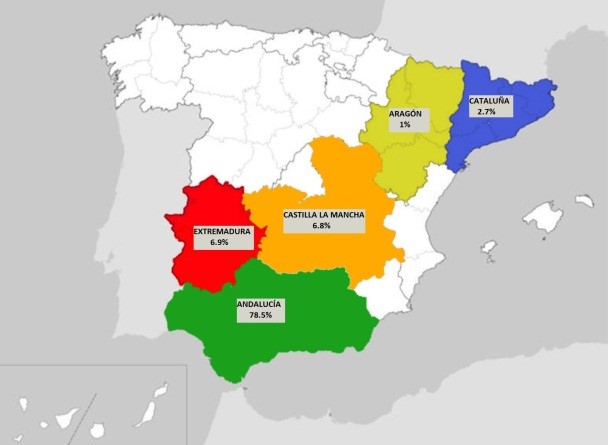
Source: Ministry of Agriculture, Fisheries and Food, Government of Spain.
Amount of Extra Virgin Olive Oil and Virgin Olive Oil produced in Spain, 2019–20 harvest.
| Regions | Tonnes (t) | Percentage (%) |
| Andalusia | 710,052 | 78.5 |
| Castilla-La Mancha | 61,230 | 6.8 |
| Extremadura | 62,124 | 6.9 |
| Catalonia | 24,393 | 2.7 |
| Aragon | 8,628 | 1.0 |
| Rest of Spain | 38,462 | 5.4 |
Olive groves cover around 15% of the total area of Andalusia. The provinces of Jaén and Córdoba are the main producers, followed by Granada and Seville.
Percentage of production (%) of Extra Virgin Olive Oil and Virgin Olive Oil by province in Andalusia (2019–20 harvest).
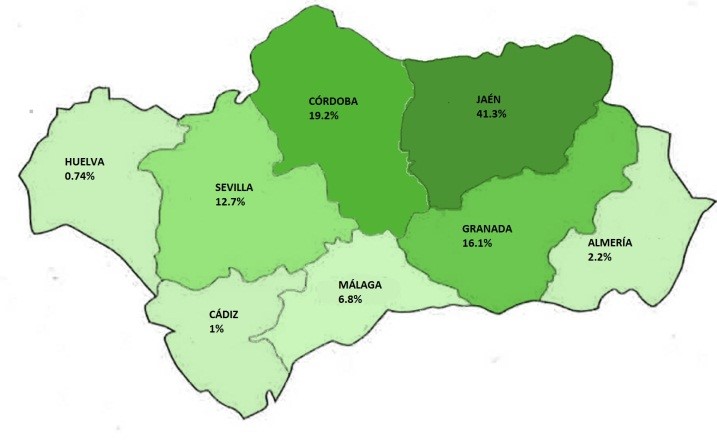
Source: Ministry of Agriculture, Fisheries and Food, Government of Spain.
Amount of Extra Virgin Olive Oil and Virgin Olive Oil produced in Andalusia, 2019–20 harvest.
| Provinces | Tonnes (t) | Percentage (%) |
| Jaén | 293,111 | 41.3 |
| Córdoba | 136,603 | 19.2 |
| Granada | 114,378 | 16.1 |
| Seville | 89,617 | 12.7 |
| Málaga | 48,268 | 6.8 |
| Almería | 15,370 | 2.2 |
| Cádiz | 6,976 | 1.0 |
| Huelva | 5,279 | 0.7 |
Jaén is also known as the "World Capital of Olive Oil". The province is particularly renowned for the cultivation of the Picual variety. Its dry climate and hot summers are ideal for olive cultivation, and olive trees can be found everywhere, from the valleys to the mountains. This spectacular "Sea of Olive Trees" has been proposed for inclusion on the UNESCO World Heritage List as the world's largest man-made forest.
.jpg)
.jpg)
“Acebuche” is a wild olive tree, the wild form of the cultivated olive tree. Its scientific name is Olea europaea var. sylvestris. It is therefore the same species as the cultivated olive tree, but grows in the wild. In fact, if an olive grove is left uncultivated for a long period of time, the olive trees gradually revert to their wild form and develop many of its characteristics.
The wild olive tree typically grows as a shrub or bush. Compared with the cultivated olive tree, its stems are thicker and more robust, while its leaves are broader and have a more vivid, intense colour.
The fruit of the wild olive tree is known in Spanish as an acebuchina. It is similar to an olive, but smaller. The amount of fruit produced by a wild olive tree is considerably lower than that produced by its cultivated relative.
In some areas, people make wild olive oil at home, as harvesting the fruit and producing the oil would not be commercially viable on a larger scale. Small home producers can occasionally be found on internet forums.
The wild olive tree is a characteristic part of the Mediterranean landscape and woodland, growing alongside holm oaks, carob trees and cork oaks. It can reach heights of up to 10 metres, although this is uncommon. It is more typically found growing as a shrub or bush. It can usually be recognised by its intense, dark green leaves.
Wild olive trees are extremely hardy, tough and resilient plants. Some specimens may even have thorns. Like cultivated olive trees, they are highly resistant to drought and can grow well in poor soils. However, just like their cultivated relatives, they do not thrive in cold conditions or excessive moisture.
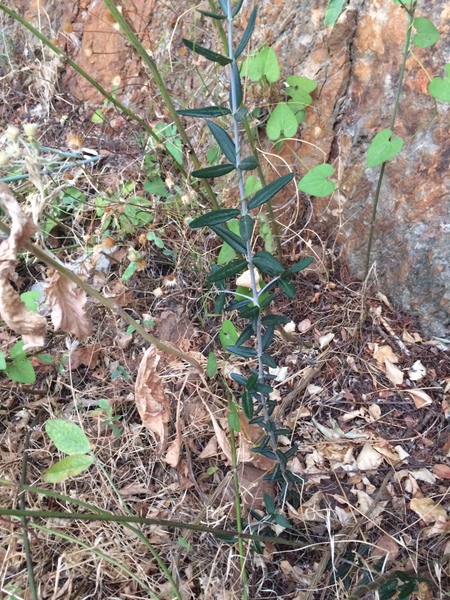
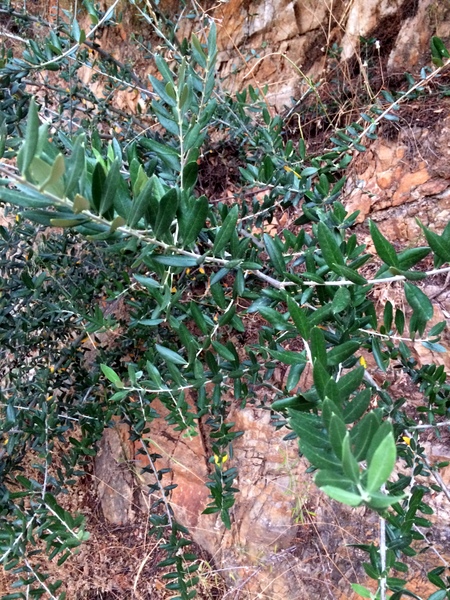
They can grow in practically any area with a Mediterranean climate.
The first photograph shows a newly sprouted wild olive tree. It was taken in an area cleared during the construction of a road in a residential development on the Andalusian Mediterranean coast.
The second photograph shows a young wild olive tree growing right next to the newly sprouted one.
If you enjoy walking in the countryside, you have probably come across more than one wild olive tree. You just need to keep your eyes open.
One possible origin of the word comes from Dioscorides, a Greek physician and botanist who is considered one of the forerunners of modern pharmacology.
Dioscorides referred to the wild olive tree as "zebbuj", while the Berbers called it "azzemur". The Spanish word acebuche is thought to have evolved from these terms.
Read more
There is not a single oil density, since there are many types of oils.
In general the relative density of most oils, both mineral and vegetable, is between 0,840 and 0,960.
A simple and general oil definition could be: oils are fatty substances that are in liquid state at room temperature.
Oils are usually classified by its origin. Mainly they are vegetable oils or mineral oils. Original animal fats are not usually liquid at room temperature and they are called butters or simply fats.
Oils density is always lower than that of the water, so that all the oils float in it and remain on the surface.
The density of the oil changes with the temperature. As the temperature rises, the oil expands, and therefore its density decreases. It is therefore necessary to express the density of the oil in relation to the temperature.
The vegetable oils density indicated below is the relative density with water at a temperature of 20 º C, except that of palm and coconut oils, which are taken at 50 and 40 °c respectively.
The above information is water-related densities at 20 º C. If you want to know the absolute density in kg/m3, for example, we only need to know the density of the water at 20 º C, which is about 998,30 kg/m3. Simply by multiplying the relative density of the oil by the density of the water we get the absolute density of the oil in kg/m3.
For example; What is the absolute density of rapeseed oil in kg/m3 at 20 º C?We take from the table the medium relative density value of rapeseed oil, 0,915 and multiply it by 998,30 kg/m3, resulting in 913,44 kg/m3.
Mineral oils are derived from petroleum distillation. There are many different types of mineral oils with multiple uses: refrigerants, dielectrics, lubricants, etc.
There are many companies that produce them and the variants that are generated with the amount of added additives are enormous.
According to the general mineral oil density, it can be said that it is between 0,840 and 0,960, in relative densities.
Below we provide our extra virgin olive oils liter prices to our customers in our bigger capacity packagings:
5 litres PET price: 53.00 €, VAT Included. The price of the liter of olive oil is 10.60 €.
2 liters PET price: 22.00 €, VAT included. The price of the liter of olive oil is 11.00 €.
1 litre PET price: 11.50 €, VAT included. The price of the liter of olive oil is 11.50 €.
2.5 liters can price: 30.00 €, VAT included. The price of the liter of olive oil is 12.00 €.
2.5 litre can price (organic olive oil): 33.00 € , VAT included. The price per litre of olive oil is 13.20 €.
Transport costs to your address are not included in above prices. In our purchasing process you can find out how much could be them.
We remember you our first purchase promotion for new customers, 5% discount of the olive oil price.
-Is produced of our own harvest, only by using for its elaboration olives from our own olive trees.
-Is produced in the mill located in the farm.
-Is produced by first cold extraction.
-Has a low level of acidity. (See analytics).
-Are 100% monovarietal olive oils: Arbequina, Picual, Hojiblanca, Manzanillo and Frantoio.
-Are from the last Olive Oil season, not from previous ones.
-Has won some prestigious awards (Ministry of Agriculture, Expoliva, Olive Japan, etc)
-Is packaged upon order, in order to preserve all its properties until you receive it.
With all that, and along with our online customers opinions, we believe we offer a fantastic extra virgin olive oil at an unbeatable price.
Unrefined olive oils are those which, once extracted, undergo no further treatment before being consumed. According to this definition, unrefined olive oils are exclusively virgin olive oils: oils obtained solely by mechanical means and which therefore never come into contact with solvents or chemical products. They are the natural juice of the olive.
However, if we take a very strict approach to the definition, raw olive pomace oil could also be considered an unrefined olive oil. However, this type of oil is not suitable for human consumption until it has undergone a refining process.
Very few vegetable oils can be consumed without being refined. This is because, in most plant species, the oil is contained inside the seed.
For example, sunflower oil is found inside sunflower seeds, which contain relatively small amounts of oil along with water. Unlike olives, sunflower seeds cannot simply be pressed to extract their oil. The same applies to rapeseed oil and many other vegetable oils.
Olive oils obtained from olives in poor sanitary conditions are also refined, as are oils affected by defective production processes or inadequate storage conditions.
Unrefined olive oils retain the natural substances found in olives, including carotenes, tocopherols and polyphenols, many of which have beneficial properties. (Composition of unrefined olive oils).
During the refining process of low-quality olive oils, such as lampante olive oil, various processes are used to remove undesirable characteristics and improve aspects such as flavour, aroma, colour and acidity. You can learn more about the refining process and refined olive oils here.
At Las Valdesas, we only produce unrefined olive oils of the highest quality, namely Extra Virgin Olive Oil. We also offer some of our olive oils not only unrefined but, in some cases, unfiltered, with minimal processing. (See the difference between filtered and unfiltered olive oils).
Every year, we analyse our olive oils to assess their quality and confirm that they are free from pesticide residues. Our aim is to offer the most natural and highest-quality olive oils possible: authentic olive juice. (See the analysis of our olive oils).
Read more
Córdoba is the second-largest olive oil-producing province in Spain, after Jaén.
Campiña Sur de Córdoba: this area lies within the triangle formed by Lucena, Puente Genil and Aguilar de la Frontera. The Lucena and Estepa Protected Designations of Origin (PDOs) are located in this area. The predominant olive variety is Hojiblanca.
Subbética Area: located in the Sierra Sur de Córdoba and the eastern part of the province. The municipalities of Baena and Priego de Córdoba are particularly notable, each with its own PDO. The main olive varieties grown in this area are Picual, Picudo and Hojiblanca.
Sierra Morena Area: the municipalities of Montoro, Adamuz and Hornachuelos are particularly noteworthy. The typical olive varieties grown in this area are Picual, Picudo and Nevadillo Negro. The area has one Protected Designation of Origin: Montoro-Adamuz.
The main olive varieties grown in the province of Córdoba are:
- Hojiblanca, mainly in the Campiña Sur area.
- Picual, throughout the province, but particularly in the area bordering Jaén.
- Picudo, a mountain variety mainly found in the Subbética and Sierra Morena areas.
- Nevadillo Negro, mainly found in Sierra Morena.
Although it is not a native variety of Córdoba, many olive groves are now also planted with the Arbequina variety.
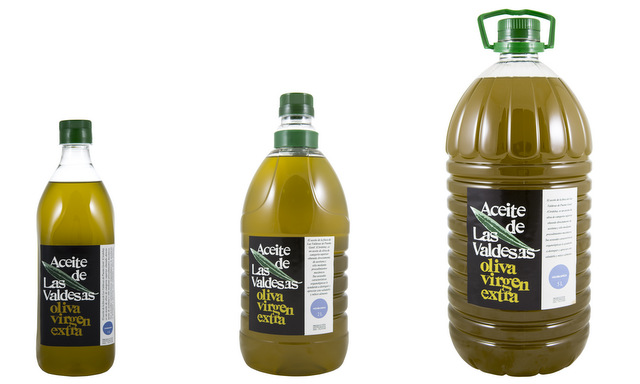
Baena PDO
Priego de Córdoba PDO
Lucena PDO
Montoro-Adamuz PDO
Estepa PDO (the left bank of the Genil River within the municipality of Puente Genil, in Córdoba, is included in this PDO)
Read more
AOVE is the acronym for Aceite de Oliva Virgen Extra (Extra Virgin Olive Oil). It is the extra virgin olive oil that has been around all our lives in Spain.
It is a term that has become much more widespread in recent years. I started seeing it on the menus of some higher-end restaurants, used as an addition to the name of certain dishes: "Oven-baked sea bass with Arbequina AOVE". I remember having dinner with my sister-in-law and asking the waiter what "AOVE" meant. She was a little disappointed with the answer.
Later, another acquaintance of mine assured me that AOVE was the name of a specific extra virgin olive oil brand.
I believe the use of the term AOVE is a reflection of the term EVOO (Extra Virgin Olive Oil), widely used in the United States, mainly by olive oil producers and experts in California.
In the English-speaking world, people are very fond of acronyms, and olive oil has been no exception.
Given the great influence of English, EVOO has become widely used internationally: EVOO contests, EVOO rankings, etc.
In Spain, there are already many companies dedicated to producing and marketing extra virgin olive oils that include AOVE in their name.
So now you know: whenever you hear or read the term AOVE, you will know what it is and what it means.
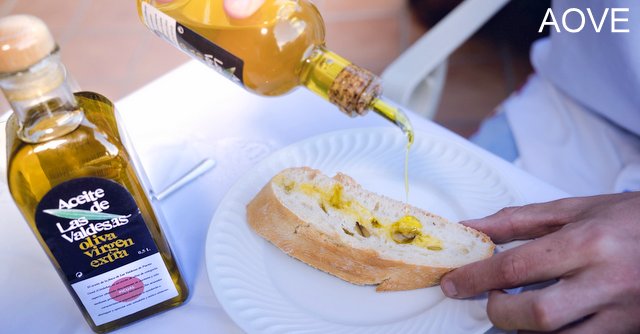
Well, since AOVE means "Aceite de Oliva Virgen Extra" (Extra Virgin Olive Oil), an AOVE must meet the requirements for an oil to be classified as Extra Virgin. You can find them here.
The best thing about the acronym AOVE is the great amount of time it saves when writing about the different types of extra virgin olive oil. This means you can talk about an Arbequina AOVE, an early-harvest AOVE, an unfiltered AOVE or an AOVE from a particular Protected Designation of Origin. You can find out more about types of AOVE here.
The meaning of AOVEE would be "Aceite de Oliva Virgen Extra Ecológico" (Organic Extra Virgin Olive Oil).
I don't know whether it will catch on, but if it does, I suppose it will be in written form because it is almost impossible to pronounce when spoken.
In the English-speaking world, it would be OEVOO, "Organic Extra Virgin Olive Oil". I think that is also impossible to pronounce in English. (At least when I try it with my best possible English accent, it feels as though my jaw is about to come unhinged. Give it a try and your maxillofacial specialist may be delighted to see you in their office.)
Read more
The main producers of olive oil are Spain, Italy, Greece, Tunisia, Turkey, Morocco, Portugal and Syria.
All of them are countries belonging to the Mediterranean basin. The production of these countries accounts for about 80% of world production.
Among them, Spain stands out as producing on average in the last 5 years more than 40% of the production worldwide.
The second most producing country is Italy, whose average over the last 5 years is 10% of the production worldwide.
We have attached a graph below with the development of the production of olive oil over the last 30 years.
It should be noted that the countries that were world leaders in the production of olive oil continue to be so today. The olive tree is an eminently traditional crop with a long production cycle.
However, three aspects can be highlighted in the graph:
| 2019/20 | 2018/19 | 2017/18 | 2016/17 | 2015/16 | 2014/15 | 2013/14 | 2012/13 | 2011/12 | 2010/11 | 2009/10 | 2008/9 | 2007/8 | 2006/07 | 2005/06 | 2004/05 | 2003/04 | 2002/03 | 2001/02 | 2000/01 | 1999/00 | 1998/99 | 1997/98 | 1996/97 | 1995/96 | 1994/95 | 1993/94 | 1992/93 | 1991/92 | 1990/91 | |
|---|---|---|---|---|---|---|---|---|---|---|---|---|---|---|---|---|---|---|---|---|---|---|---|---|---|---|---|---|---|---|
| Spain | 1230,0 | 1789,9 | 1262,2 | 1290,6 | 1403,3 | 842,2 | 1781,5 | 618,2 | 1615,0 | 1391,9 | 1401,5 | 1030,0 | 1236,1 | 1111,4 | 826,9 | 989,8 | 1412,0 | 861,1 | 1411,4 | 973,7 | 669,1 | 791,9 | 1077,0 | 947,3 | 337,6 | 538,8 | 550,9 | 623,1 | 593,0 | 639,4 |
| Italy | 340,0 | 173,6 | 428,9 | 182,3 | 474,6 | 222,0 | 463,7 | 415,5 | 399,2 | 440,0 | 430,0 | 540,0 | 510,0 | 490,0 | 636,5 | 879,0 | 685,0 | 634,0 | 656,7 | 509,0 | 735,0 | 403,5 | 620,0 | 370,0 | 620,0 | 448,0 | 520,0 | 435,0 | 674,5 | 163,3 |
| Greece | 300,0 | 185,0 | 346,0 | 195,0 | 320,0 | 300,0 | 132,0 | 357,9 | 294,6 | 301,0 | 320,0 | 305,0 | 327,2 | 370,0 | 424,0 | 435,0 | 308,0 | 414,0 | 358,3 | 430,0 | 420,0 | 473,0 | 375,0 | 390,0 | 400,0 | 350,0 | 254,0 | 310,0 | 385,0 | 170,0 |
| Tunisia | 300,0 | 140,0 | 325,0 | 100,0 | 140,0 | 340,0 | 70,0 | 220,0 | 182,0 | 120,0 | 150,0 | 160,0 | 170,0 | 160,0 | 220,0 | 130,0 | 280,0 | 72,0 | 35,0 | 130,0 | 210,0 | 215,0 | 93,0 | 270,0 | 60,0 | 100,0 | 235,0 | 120,0 | 250,0 | 175,0 |
| Turkey | 225,0 | 193,5 | 263,0 | 178,0 | 150,0 | 160,0 | 135,0 | 195,0 | 191,0 | 160,0 | 147,0 | 130,0 | 72,0 | 165,0 | 112,0 | 145,0 | 79,0 | 140,0 | 65,0 | 175,0 | 70,0 | 170,0 | 40,0 | 200,0 | 40,0 | 160,0 | 48,0 | 56,0 | 60,0 | 80,0 |
| Morocco | 145,0 | 200,0 | 140,0 | 110,0 | 130,0 | 120,0 | 130,0 | 100,0 | 120,0 | 130,0 | 140,0 | 85,0 | 85,0 | 75,0 | 75,0 | 50,0 | 100,0 | 45,0 | 60,0 | 35,0 | 40,0 | 65,0 | 70,0 | 110,0 | 35,0 | 45,0 | 40,0 | 38,0 | 50,0 | 36,0 |
| Portugal | 125,4 | 100,3 | 134,8 | 69,4 | 109,1 | 61,0 | 91,6 | 59,2 | 76,2 | 62,9 | 62,5 | 53,4 | 36,3 | 47,5 | 29,1 | 41,2 | 31,2 | 28,9 | 33,7 | 24,6 | 50,2 | 35,1 | 42,0 | 44,8 | 43,7 | 32,2 | 32,1 | 22,0 | 62,0 | 20,0 |
| Syria | 120,0 | 100,0 | 100,0 | 110,0 | 110,0 | 105,0 | 180,0 | 175,0 | 198,0 | 180,0 | 150,0 | 130,0 | 100,0 | 154,0 | 100,0 | 175,0 | 110,0 | 165,0 | 92,0 | 165,0 | 81,0 | 115,0 | 70,0 | 125,0 | 76,0 | 90,0 | 65,0 | 86,0 | 42,0 | 83,0 |
Due to the recognition of olive oil as one of the healthiest fats for our cardiovascular system, among other benefits, olive cultivation has interested many countries without an olive tradition.
Countries with potential for the cultivation of olive groves because they have areas with a Mediterranean climate have begun to produce olive oil. We can highlight Algeria, Argentina, Chile, United States (California), Australia, Egypt and China.
Little by little they are increasing their production, although today it is anecdotal with respect to the main producers.
| 2019/20 | 2018/19 | 2017/18 | 2016/17 | 2015/16 | 2014/15 | 2013/14 | 2012/13 | 2011/12 | 2010/11 | 2009/10 | 2008/9 | 2007/8 | 2006/07 | 2005/06 | 2004/05 | 2003/04 | 2002/03 | 2001/02 | 2000/01 | 1999/00 | 1998/99 | 1997/98 | 1996/97 | 1995/96 | 1994/95 | 1993/94 | 1992/93 | 1991/92 | 1990/91 | |
|---|---|---|---|---|---|---|---|---|---|---|---|---|---|---|---|---|---|---|---|---|---|---|---|---|---|---|---|---|---|---|
| Spain | 1230,0 | 1789,9 | 1262,2 | 1290,6 | 1403,3 | 842,2 | 1781,5 | 618,2 | 1615,0 | 1391,9 | 1401,5 | 1030,0 | 1236,1 | 1111,4 | 826,9 | 989,8 | 1412,0 | 861,1 | 1411,4 | 973,7 | 669,1 | 791,9 | 1077,0 | 947,3 | 337,6 | 538,8 | 550,9 | 623,1 | 593,0 | 639,4 |
| Italy | 340,0 | 173,6 | 428,9 | 182,3 | 474,6 | 222,0 | 463,7 | 415,5 | 399,2 | 440,0 | 430,0 | 540,0 | 510,0 | 490,0 | 636,5 | 879,0 | 685,0 | 634,0 | 656,7 | 509,0 | 735,0 | 403,5 | 620,0 | 370,0 | 620,0 | 448,0 | 520,0 | 435,0 | 674,5 | 163,3 |
| Greece | 300,0 | 185,0 | 346,0 | 195,0 | 320,0 | 300,0 | 132,0 | 357,9 | 294,6 | 301,0 | 320,0 | 305,0 | 327,2 | 370,0 | 424,0 | 435,0 | 308,0 | 414,0 | 358,3 | 430,0 | 420,0 | 473,0 | 375,0 | 390,0 | 400,0 | 350,0 | 254,0 | 310,0 | 385,0 | 170,0 |
| Tunisia | 300,0 | 140,0 | 325,0 | 100,0 | 140,0 | 340,0 | 70,0 | 220,0 | 182,0 | 120,0 | 150,0 | 160,0 | 170,0 | 160,0 | 220,0 | 130,0 | 280,0 | 72,0 | 35,0 | 130,0 | 210,0 | 215,0 | 93,0 | 270,0 | 60,0 | 100,0 | 235,0 | 120,0 | 250,0 | 175,0 |
| Turkey | 225,0 | 193,5 | 263,0 | 178,0 | 150,0 | 160,0 | 135,0 | 195,0 | 191,0 | 160,0 | 147,0 | 130,0 | 72,0 | 165,0 | 112,0 | 145,0 | 79,0 | 140,0 | 65,0 | 175,0 | 70,0 | 170,0 | 40,0 | 200,0 | 40,0 | 160,0 | 48,0 | 56,0 | 60,0 | 80,0 |
| Morocco | 145,0 | 200,0 | 140,0 | 110,0 | 130,0 | 120,0 | 130,0 | 100,0 | 120,0 | 130,0 | 140,0 | 85,0 | 85,0 | 75,0 | 75,0 | 50,0 | 100,0 | 45,0 | 60,0 | 35,0 | 40,0 | 65,0 | 70,0 | 110,0 | 35,0 | 45,0 | 40,0 | 38,0 | 50,0 | 36,0 |
| Portugal | 125,4 | 100,3 | 134,8 | 69,4 | 109,1 | 61,0 | 91,6 | 59,2 | 76,2 | 62,9 | 62,5 | 53,4 | 36,3 | 47,5 | 29,1 | 41,2 | 31,2 | 28,9 | 33,7 | 24,6 | 50,2 | 35,1 | 42,0 | 44,8 | 43,7 | 32,2 | 32,1 | 22,0 | 62,0 | 20,0 |
| Syria | 120,0 | 100,0 | 100,0 | 110,0 | 110,0 | 105,0 | 180,0 | 175,0 | 198,0 | 180,0 | 150,0 | 130,0 | 100,0 | 154,0 | 100,0 | 175,0 | 110,0 | 165,0 | 92,0 | 165,0 | 81,0 | 115,0 | 70,0 | 125,0 | 76,0 | 90,0 | 65,0 | 86,0 | 42,0 | 83,0 |
|
Algeria |
82,5 | 97,0 | 82,5 | 63,0 | 82,0 | 69,5 | 44,0 | 66,0 | 39,5 | 67,0 | 26,5 | 61,5 | 24,0 | 21,5 | 32,0 | 33,5 | 69,5 | 15,0 | 25,5 | 26,5 | 33,5 | 54,5 | 15,0 | 50,5 | 51,5 | 16,5 | 21,0 | 27,0 | 37,0 | 6,0 |
| Argentina | 26,0 | 27,5 | 45,0 | 24,0 | 24,0 | 30,0 | 30,0 | 17,0 | 32,0 | 20,0 | 17,0 | 23,0 | 27,0 | 15,0 | 23,0 | 18,0 | 13,5 | 11,0 | 10,0 | 4,0 | 11,0 | 6,5 | 8,0 | 11,5 | 11,0 | 6,5 | 8,0 | 10,0 | 9,0 | 8,0 |
| Egypt | 27,5 | 7,0 | 39,5 | 30,0 | 16,5 | 17,0 | 20,0 | 16,5 | 9,0 | 4,0 | 3,0 | 5,0 | 7,5 | 10,5 | 2,5 | 2,5 | 2,0 | 5,0 | 1,5 | 0,5 | 2,5 | 0,5 | 1,0 | 0,5 | 2,5 | 1,0 | 1,0 | 1,0 | 1,0 | 0,5 |
| Chile | 20,0 | 19,0 | 22,0 | 20,0 | 17,5 | 18,5 | 15,0 | 15,0 | 21,5 | 16,0 | 12,0 | 8,5 | 6,5 | 5,0 | ||||||||||||||||
| Jordan | 25,5 | 21,0 | 21,0 | 20,0 | 29,5 | 23,0 | 19,0 | 21,5 | 19,5 | 27,0 | 17,0 | 18,5 | 21,5 | 37,0 | 22,0 | 29,0 | 25,0 | 28,0 | 14,0 | 27,0 | 6,5 | 21,5 | 14,0 | 23,0 | 14,0 | 13,5 | 12,5 | 14,0 | 5,0 | 8,0 |
| Australia | 21,0 | 19,0 | 21,0 | 21,0 | 20,0 | 19,5 | 13,5 | 9,5 | 15,5 | 18,0 | 18,0 | 15,0 | 12,0 | 9,0 | 9,0 | 5,0 | 2,5 | 2,0 | 1,0 | 1,0 | 0,5 | 0,5 | ||||||||
| Palestine | 23,0 | 15,0 | 19,5 | 20,0 | 21,0 | 24,5 | 17,5 | 15,5 | 15,5 | 25,0 | 5,5 | 20,0 | 8,0 | 31,5 | 10,0 | 20,0 | 5,0 | 21,5 | 18,0 | 20,0 | 2,0 | 5,5 | 9,0 | 12,0 | 12,0 | 8,0 | 1,0 | 31,0 | ||
| Libya | 16,5 | 16,0 | 18,0 | 16,0 | 18,0 | 15,5 | 18,0 | 15,0 | 15,0 | 15,0 | 15,0 | 15,0 | 13,0 | 11,0 | 9,0 | 12,5 | 12,5 | 6,5 | 7,0 | 4,0 | 7,0 | 8,0 | 6,0 | 10,0 | 4,0 | 6,5 | 8,0 | 6,0 | 10,0 | 7,0 |
| Israel | 19,0 | 16,0 | 17,0 | 18,0 | 18,0 | 18,5 | 15,0 | 18,0 | 13,0 | 12,5 | 3,5 | 9,0 | 4,0 | 8,5 | 3,0 | 9,0 | 3,0 | 9,0 | 3,5 | 7,0 | 2,5 | 4,5 | 3,0 | 5,5 | 5,0 | 5,5 | 1,5 | 7,5 | 2,5 | 8,0 |
| Lebanon | 19,0 | 24,0 | 17,0 | 25,0 | 23,0 | 21,0 | 16,5 | 14,0 | 14,0 | 32,0 | 9,0 | 12,0 | 10,5 | 6,0 | 5,5 | 6,0 | 7,5 | 6,0 | 5,0 | 6,0 | 5,0 | 7,0 | 3,5 | 6,5 | 5,0 | 5,0 | 2,0 | 8,0 | 5,0 | 6,0 |
| United States | 16,0 | 16,0 | 16,0 | 15,0 | 14,0 | 5,0 | 12,0 | 4,0 | 4,0 | 4,0 | 3,0 | 3,0 | 2,0 | 1,0 | 1,0 | 1,5 | 1,0 | 1,0 | 0,5 | 0,5 | 1,0 | 1,0 | 1,0 | 1,0 | 1,0 | 1,0 | 4,5 | 1,0 | 0,5 | 1,0 |
| Albania | 11,0 | 11,0 | 11,0 | 11,5 | 10,0 | 11,0 | 10,5 | 12,0 | 7,0 | 8,0 | 5,0 | 6,0 | 4,0 | |||||||||||||||||
| Iran | 9,0 | 7,0 | 7,0 | 3,5 | 5,0 | 4,5 | 5,0 | 3,5 | 7,0 | 4,0 | 4,0 | 4,5 | 4,5 | 4,0 | 4,5 | 4,0 | 2,5 | 1,5 | 2,5 | 3,0 | 2,5 | 2,5 | 3,0 | 1,5 | 3,0 | 1,5 | 3,0 | 2,0 | 0,5 | 0,5 |
| France | 5,9 | 5,5 | 6,2 | 3,3 | 5,4 | 1,7 | 4,8 | 5,1 | 3,2 | 6,1 | 5,7 | 7,0 | 4,7 | 3,3 | 4,4 | 4,7 | 4,6 | 4,7 | 3,6 | 3,2 | 4,1 | 3,4 | 2,7 | 2,5 | 2,3 | 2,0 | 2,3 | 1,6 | 4,3 | 1,0 |
| China | 6,0 | 5,5 | 6,0 | 5,0 | 5,0 | 2,5 | ||||||||||||||||||||||||
| Croatia | 3,5 | 3,4 | 3,9 | 5,0 | 5,5 | 1,1 | 4,6 | 4,0 | 4,0 | 5,0 | 5,0 | 6,0 | 4,5 | 4,0 | 5,0 | 5,0 | 3,0 | 7,0 | 5,0 | 5,5 | 9,0 | 5,0 | 1,5 | |||||||
| Saudi Arabia | 3,0 | 3,0 | 3,0 | 3,0 | 3,0 | 3,0 | 3,0 | 3,0 | 3,0 | 3,0 | 3,0 | 3,0 | 3,0 | 2,5 | ||||||||||||||||
| Uruguay | 2,0 | 0,5 | 1,0 | 0,5 | 0,5 | 0,5 | 0,5 | |||||||||||||||||||||||
| Montenegro | 0,5 | 0,5 | 0,5 | 0,5 | 0,5 | 0,5 | 0,5 | 0,5 | 0,5 | 0,5 | 0,5 | 0,5 | 0,5 | 0,5 | 0,5 | 0,5 | 0,5 | 0,5 | 0,5 | 0,5 | 1,0 | 1,0 | 0,5 | 0,5 | 1,5 | 2,5 | 2,0 | 1,5 | 2,0 | 3,5 |
| Slovenia | 0,3 | 0,9 | 0,4 | 0,4 | 0,5 | 0,2 | 0,6 | 0,2 | 0,5 | 0,7 | 0,7 | 0,5 | 0,4 | 0,3 | 0,5 | 0,0 | 0,2 | |||||||||||||
| Malta | 0,0 | 0,0 | 0,0 | 0,0 | 0,0 | 0,1 | 0,0 | |||||||||||||||||||||||
| Cyprus | 6,0 | 4,7 | 6,0 | 6,0 | 6,0 | 6,2 | 3,8 | 5,6 | 6,5 | 6,5 | 4,2 | 2,8 | 4,0 | 8,3 | 7,2 | 7,5 | 7,0 | 7,0 | 6,5 | 5,5 | 3,5 | 2,5 | 1,5 | 2,0 | 2,5 | 3,0 | 3,0 | 3,0 | 1,5 | 2,0 |
| Mexico | 0,0 | 0,0 | 0,0 | 0,0 | 0,0 | 0,0 | 0,0 | 0,0 | 2,0 | 2,5 | 2,5 | 2,5 | 2,0 | 1,5 | 1,0 | 2,5 | 2,0 | 2,5 | 2,0 | 2,0 | 3,0 | 2,0 | 2,0 | 2,5 | ||||||
| Other countries | 217,0 | 193,5 | 199,0 | 205,0 | 199,5 | 182,5 | 252,5 | 236,5 | 272,0 | 251,0 | 216,0 | 189,5 | 153,5 | 201,5 | 128,0 | 198,0 | 130,0 | 185,5 | 110,5 | 183,0 | 96,5 | 134,0 | 87,0 | 145,5 | 91,0 | 107,0 | 86,5 | 101,0 | 62,5 | 150,5 |
| World Production | 3345,6 | 3395,3 | 3562,4 | 2751,0 | 3361,4 | 2626,0 | 3490,1 | 2623,2 | 3578,2 | 3311,1 | 3174,6 | 2843,7 | 2851,7 | 2953,3 | 2692,6 | 3204,2 | 3297,0 | 2673,7 | 2928,7 | 2741,0 | 2464,4 | 2528,9 | 2545,7 | 2732,1 | 1820,6 | 1945,5 | 1904,3 | 1906,7 | 2259,3 | 1571,2 |
Olive oil has many uses in many different areas of our lives.
Some of the most common uses are the following:
Olive oil is a vegetable fat used mainly as a food. It provides 9 kcal per gram. Our bodies use it mainly as a source of energy and as a source of fatty acids needed to build and maintain cell membranes.
The most common uses of olive oil in the kitchen are:
- For dressing salads and seasoning meat and other foods.
- As an ingredient in sauces, such as mayonnaise, aioli and vinaigrettes.
- In Mediterranean countries, it is commonly used to fry food, including meat, fish, potatoes, aubergines and croquettes. (Tips for frying with olive oil and the advantages of frying with olive oil.)
- Olive oil is served in some high-end restaurants with bread as a starter, sometimes replacing butter.
- Olive oil is also consumed raw at breakfast with toasted bread. In some regions, it is served with crushed tomatoes, garlic, salt or sugar. (How to choose the best olive oil for breakfast).
- Olive oil can also be used as a preservative. Because it creates a barrier that limits contact with air, it has traditionally been used to preserve certain foods. This is why it is used in the canning industry: sardines in olive oil, tuna in olive oil, octopus in olive oil, and so on. It has also traditionally been used at home to preserve foods such as cheese and pork in olive oil or lard.
- Mild olive oils are increasingly used in baking. Olive oil can be used in cakes, cookies and biscuits as an alternative to butter. (Using olive oil in baking).
Olive oil has many health benefits, and more and more are being discovered through scientific research.
- Olive oil, together with a balanced diet and a little daily exercise, can help to reduce the risk of cardiovascular disease.
- Olive oil can help to reduce total cholesterol levels, helping to reduce bad cholesterol (LDL) and increase good cholesterol (HDL). (How does olive oil help to reduce cholesterol?)
- Extra virgin olive oil with high levels of polyphenols helps to prevent triglycerides from oxidising in the bloodstream and causing damage to blood vessels.
- Olive oil can help to reduce the Omega-6/Omega-3 ratio. Currently, this ratio is around 10, while experts suggest that it should be between 3 and 5. This ratio is so high today because the food industry uses many oils rich in Omega-6, such as sunflower oil, in processed foods. Since olive oil is mainly rich in Omega-9, replacing sunflower oil with olive oil helps to reduce this ratio.
- Olive oil also improves intestinal transit and can help with bad breath.
- Olive oil is often used as a gastric protector. Some mothers give their children a few tablespoons before they go out at weekends and consume alcohol.
- Some scientific studies have recently been carried out in which the consumption of olive oil has been associated with a lower incidence of certain types of cancer. In addition, a molecule found in olive oil, oleocanthal, has anti-inflammatory properties similar to those of ibuprofen, and some studies have demonstrated antitumour activity in vitro.
You can learn about all the benefits of olive oil in this article.
Olive oil has an important role in both the Old and New Testaments and has traditionally been associated with anointing and religious ceremonies.
- The prophet Samuel anointed Saul with oil when he became King of Israel. The same ritual was associated with the anointing of other kings. The word Christ comes from the Greek word meaning “anointed”, referring to this tradition of anointing.
- Olive oil is also used as the basis for certain holy oils used in Christian rites, including the anointing of the sick and chrism, which is used in baptism and confirmation.
- Olive oil can be used as a homemade lubricant. It can help lubricate squeaky hinges and can also be used on certain chains and bicycle components.
- Olive oil can also provide temporary protection for metal parts against oxidation.
- In certain circumstances, olive oil has been used as a fuel for motor vehicles. This is highly unusual because olive oil is expensive compared with conventional fuels. For example, in Spain, some truck engines were modified after the Spanish Civil War so that they could run on olive oil.
- In ancient times, olive oil was widely used as fuel for oil lamps. Lower-quality olive oil, known as lampante olive oil, was traditionally used for this purpose. The term lampante is still used today to describe a category of olive oil that is not suitable for human consumption without further processing.
Read more
The olive tree flower has several names depending on the region. The most common are rapa, esquimo, cadillo and trama, although in some areas the latter name is used to refer to the small green, button-shaped shoot that will eventually develop into the flower.
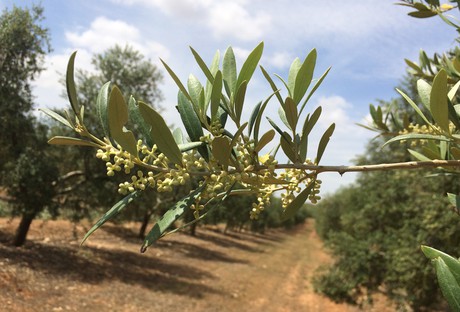
Olive tree flowers are small and grow in clusters containing between ten and fifty flowers, depending on the olive tree variety. They are whitish in colour with a yellow centre and consist of four petals, a small calyx, a uniform corolla, two stamens and a four-lobed limb.
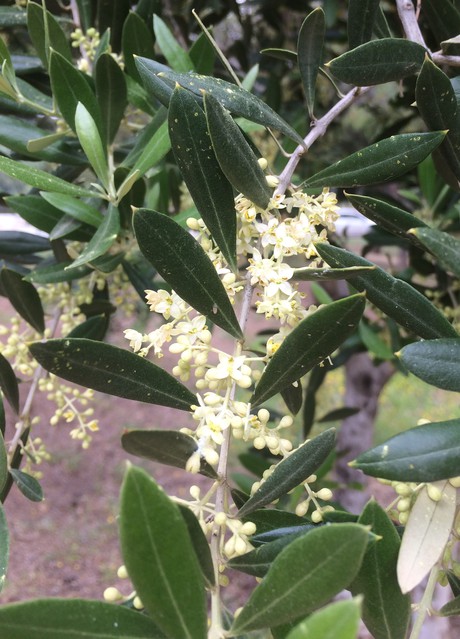
Olive tree flowers have a light, delicate scent. Because the flowers are small and white, the flowering of the olive tree often goes visually unnoticed by people who are unfamiliar with olive cultivation. What is more noticeable is the accumulation of pollen in areas with large expanses of olive groves, such as Andalusia.
Although there is some variation in the timing of flowering, it usually takes place during the middle weeks of May.
This is a critical period for the future harvest, as a poor flowering will generally result in a smaller crop.
Sometimes temperatures rise considerably in May, causing the flowers to dry out before they can be pollinated and produce fruit.
In fact, the most significant crop forecasts are usually carried out after flowering, when the fruit set can be estimated. In other words, this is when farmers assess how many female flowers have been fertilised and have developed into small olives.
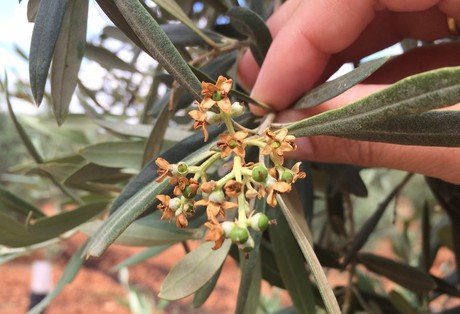
In general, olive trees flower from May onwards. At this time, pollen travels through the air and reaches the female flowers, where fertilisation takes place. An embryo then forms inside the developing fruit, marking the beginning of its growth.
Some olive tree flowers are hermaphroditic, meaning that they have both male and female reproductive organs (stamens and pistils) and can therefore develop into fruit. Others, however, produce only pollen and are male flowers, which do not produce fruit.
Another very interesting phenomenon in the pollination process is that, in very exceptional circumstances, pollen from an olive tree will fertilise flowers of the same variety. For this reason, nature relies on cross-pollination between varieties to help ensure the continuity and strength of the species.
As an interesting fact, only around 2% of all the flowers produced during flowering complete the entire cycle and develop into olives. The olive tree subsequently sheds those fruits that it cannot sustain for the remainder of its annual cycle.
Read more